

The Most Significant Issues CEOs Expect in 2026
Sustainability Risks Are Not Separate Risks: What CEOs Are Really Signaling for 2026
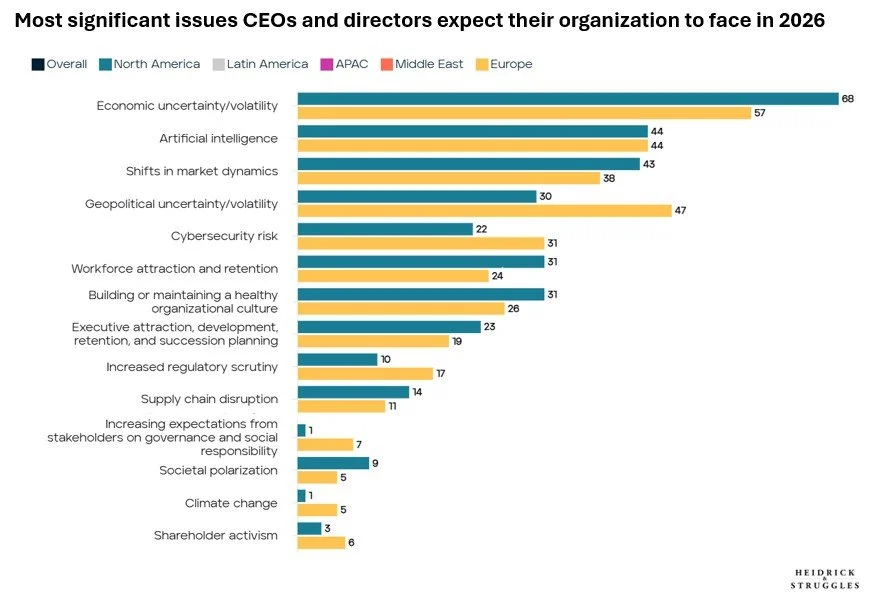
In fall 2025, executive search firm Heidrick & Struggles surveyed CEOs and board directors for its Confidence Monitor 2026* report. One of the questions asked top executives to identify the most significant issues they expect their organizations to face in 2026.
At first glance, one result may appear surprising: among 14 listed concerns, climate change ranked as the least important issue.
However, a closer look suggests something more nuanced. Many of the issues that CEOs ranked higher are, in fact, deeply connected to sustainability — even if they are not labeled as such.
This is one of the reasons sustainability remains highly relevant for businesses today: not as a standalone function, but as a strategic framework that connects operational, financial, environmental, and social risks.
The Problem With Looking at Risks in Isolation
Business risks rarely exist in silos anymore.
Supply chain disruption, workforce attraction, changing customer expectations, corporate reputation, governance pressure, and operational resilience are increasingly interconnected. Addressing one challenge without considering the others has become difficult — and in some cases impossible.
Take supply chains as an example.
Many companies are currently focused on resilience, diversification, and continuity planning. But supply chain disruptions cannot be analyzed properly without considering climate-related risks such as:
floods,
extreme weather events,
droughts,
heatwaves,
transportation interruptions,
and resource scarcity.
A supplier network that looks cost-efficient on paper may become highly vulnerable under climate stress.
Consumer Expectations Are Changing
Another issue highlighted indirectly through CEO concerns is the evolution of customer behavior.
Companies that ignore environmental, social, and ethical concerns increasingly face reputational and commercial risks — particularly among Millennials and Generation Z consumers.
This shift is not driven only by activism. It is also driven by changing market dynamics and purchasing expectations.
Consumers today are more likely to ask questions such as:
Where are products sourced?
How are employees treated?
Does the company act responsibly?
Are sustainability claims credible?
For many sectors, sustainability is no longer only a communications topic. It has become part of brand trust and long-term competitiveness.
Workforce Challenges Are Also Sustainability Challenges
The same dynamic applies internally.
Many organizations identify workforce attraction and retention as major strategic concerns. Yet employee expectations are evolving alongside broader societal expectations.
Millennial and Gen Z employees increasingly evaluate employers not only on salary and career progression, but also on:
organizational culture,
purpose,
ethical behavior,
diversity and inclusion,
flexibility,
and environmental responsibility.
In this context, sustainability influences talent strategy as much as it influences external reputation.
Governance and Communications Are Becoming More Complex
The rise of social media and digital communication has fundamentally changed how corporate behavior is scrutinized.
Today, information spreads quickly and publicly. Stakeholders — including investors, customers, employees, and civil society — increasingly expect companies to respond to governance and societal issues in real time.
This creates a more complex operating environment for leadership teams. Corporate communications can no longer function independently from operational realities. Sustainability claims, governance practices, and social impact are continuously examined by external audiences.
As a result, governance and sustainability are becoming more tightly linked.
Sustainability Is a Strategic Management Tool
The findings from the CEO survey ultimately point to a broader conclusion:
Executives are not facing separate risks. They are navigating a complex web of interconnected challenges with multiple cause-and-effect relationships.
This is precisely why sustainability remains relevant — even when climate change itself is not ranked as the top standalone concern.
Sustainability helps companies:
understand interconnected risks,
improve resilience,
anticipate stakeholder expectations,
strengthen long-term competitiveness,
and make more informed strategic decisions.
For SMEs as well as large corporations, sustainability should not be treated as a side initiative or a reporting exercise alone.
It is increasingly becoming a strategic management tool necessary for operating in a volatile and interconnected business environment.
Final Thought
When leaders discuss supply chains, workforce retention, governance pressure, or changing customer expectations, they are often discussing sustainability — whether they use that word or not.
The terminology may evolve.
The business relevance does not.
Source: 2026 CEO & Board Confidence Monitor: Explore the data.
